NIEOS
SDR FLOW Powered by NIEOS
Who Compares
Operational ICP · Two layers, one execution chain

Operational ICP.
From Playbook to Prospect.

Your ICP says who. Your dossier says how. The full-funnel revenue agency that delivers the strategy layer + operational layer + the platform and production in a single integrated engagement. We codify your Playbook into a workflow your team executes, with the strategic artifacts owned by you.

3
Dossier Pages · Strategy · Engagement · Qualification
~87
Intelligence Fields per Dossier
6 min
SDR Review Time per Dossier
~6.5 hrs
Analyst Equivalent Compressed
Operational ICP, defined

Two operational layers. One execution chain.

Your ICP scores who to pursue. Your dossier delivers the per-prospect intelligence to engage them. Both layers carry standalone value; together they're Operational ICP: the execution layer between ABM strategy and prospect-level action.

LAYER 01 · OPERATIONAL ICP

The ICP says who.

Quantified, scored, evidence-backed targeting that operates at the account level. The ICP decides which accounts to pursue, and which the SDR should never touch. Built from two evidence layers (Strategic Fit + Performance) with customer voice depth and persona affinity scoring. Delivered via the Foundation: a 40+ page board-grade ICP report. Evidence-backed, sourced per claim, with a 90-day operational roadmap.

Standalone value · Built by the Foundation
LAYER 02 · ANALYST-GRADE DOSSIER

The dossier says how.

3-page artifact per prospect. Strategic intelligence + engagement plan + MEDDPICC + 3-Layer ICP Fit qualification. ~87 fields. ~6.5 hours of analyst research compressed into a 6-minute SDR review. Companion MEDDPICC intake worksheet operationalizes qualification at the conversation level. Same artifact at every plan tier.

Standalone value · An hour of unguided research becomes a targeted 6-minute review
Included infrastructure
NIEOS GTM Orchestrator
The orchestration and intelligence engine that powers SDR Flow. Scoped access included.
Enrichment credits
Monthly enrichment budget included per plan. Overage available as needed.
+
Intent Module · Coming Soon
Bombora-driven account prioritization in the scorer. Value = timing.
From the Foundation
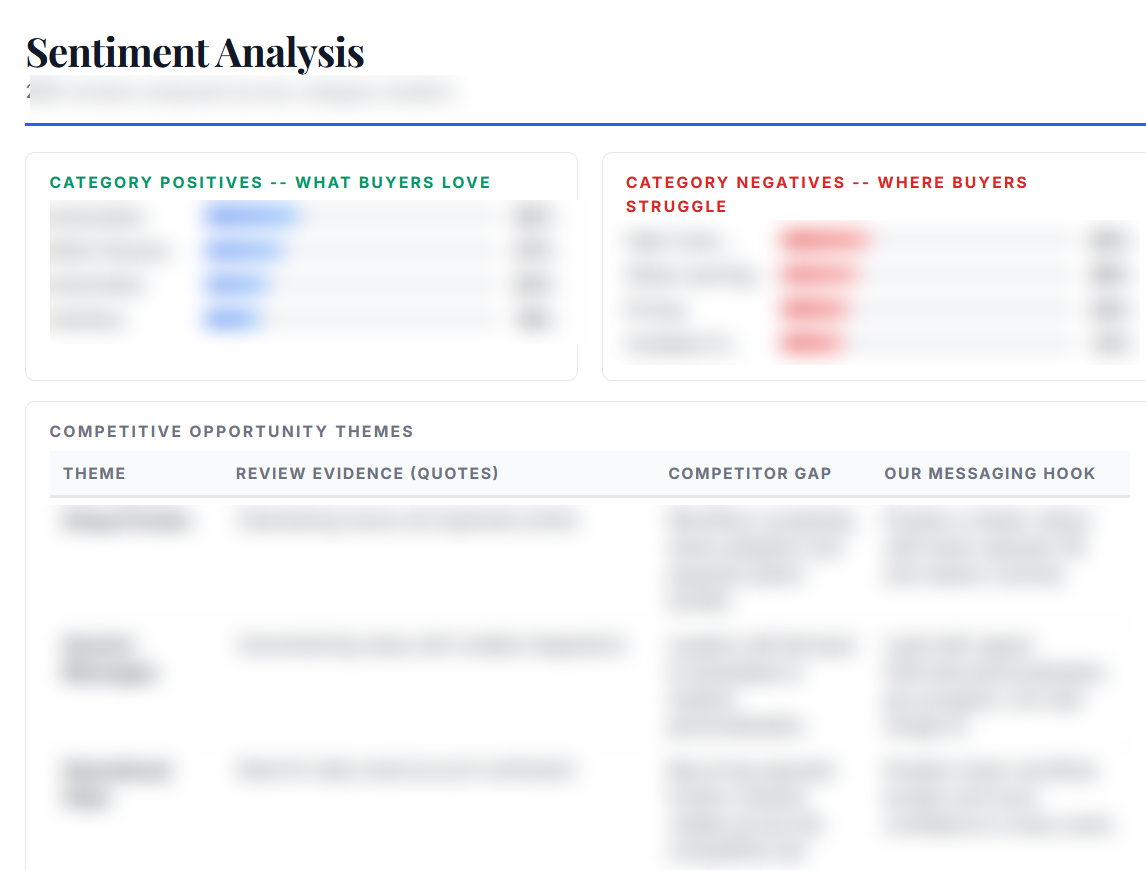
Customer voice analysis from review evidence
The substrate that calibrates everything

The substrate, behind the system.

A board-grade ICP playbook covering who to pursue, why they buy, and how to engage them. Built from codified frameworks and evidence layers.

The Foundation builds it. Customer voice, persona behavior, competitive landscape, conjoint-style USP validation, and NAICS benchmarks composed into a quantified, confidence-scored ICP.

In Product
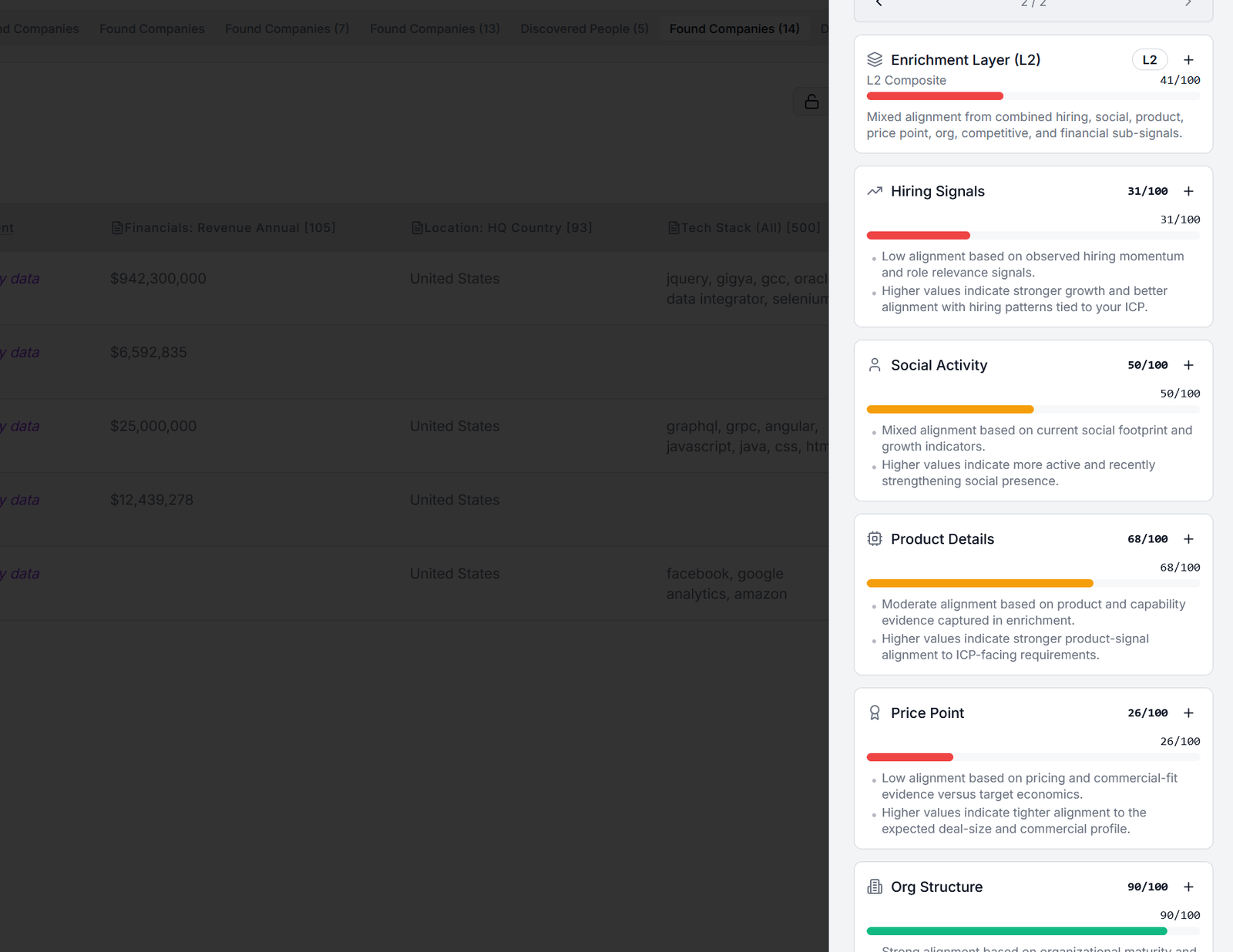
ICP Grading panel showing per-dimension scores
ICP, Operationalized

ICP Made Operational.

Most companies leave you with a deck and advice. We make your ICP a workflow.

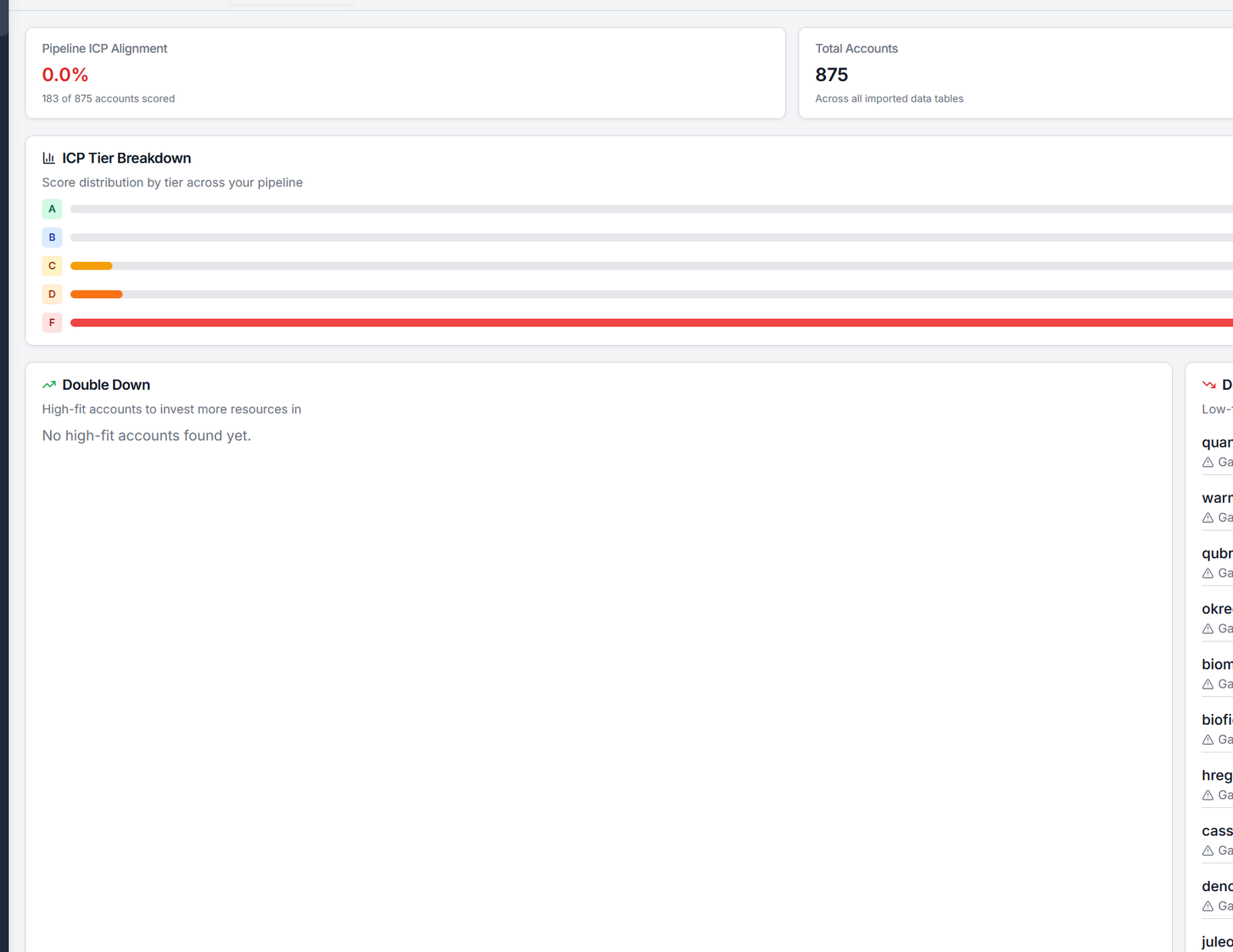
The Foundation's ICP doesn't sit in a PDF. It runs as a live scorer grading every account on every dimension, with tier-weighted analytics that surface which accounts to double-down on and which to deprioritize.

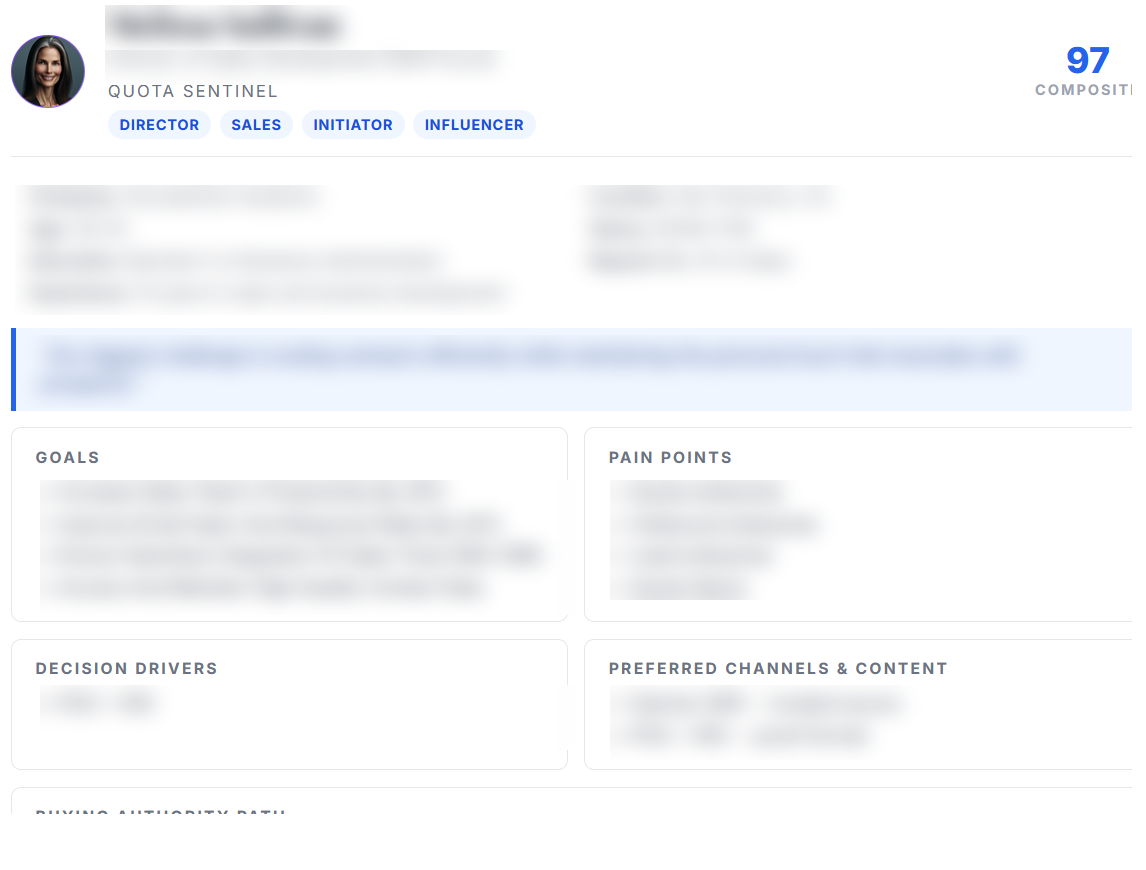
Sample · Dossier
Prospect Intelligence Dossier Generated March 18, 2026 · Confidential
MR

Marcus Reeves

Co-Founder & CRO · Arcwise Technologies
Austin, TX  ·  LinkedIn Profile  ·  marcus@arcwise.io
A
Arcwise Technologies
Supply Chain Visibility Platform · Series A · arcwise.io
68
Employees
$22M
Funded
41
US Based
83
Thesis Confidence
48
Counter-Thesis
91%
Profile Completeness
Pain-Aware
Recommended Angle
Executive Summary

Arcwise Technologies is a well-funded supply chain visibility startup with strong mid-market traction that is struggling to scale its outbound pipeline in proportion to its product maturity. The company has grown from a founding team of four to sixty-eight employees in two years, but the commercial team, five salespeople and one marketing hire, has not kept pace. Marcus, as co-founder and CRO, personally manages the top twenty accounts, creating a dependency bottleneck that limits new business velocity.

🎯
Section 02
Pain & Challenge Analysis
Primary Challenge

Arcwise has 12 months of Series A runway and needs to demonstrate repeatable sales motion to secure Series B. Pipeline is founder-dependent. Marcus sources and closes over half of all new business.

Function Bottleneck

No dedicated SDR function. AEs are expected to prospect, qualify, demo, and close, a full-cycle model that caps output at ~15 new conversations per week.

A Dossier · in the wild

From Identification to Outreach in Minutes.

Your per prospect ICP. Actionable intelligence that brings your playbook to execution.

Analyst-Grade intelligence in an agency-spec deliverable that converts research time to sales time for your GTM team.

SDR skim vs SDR Flow dossier

A 45-minute skim is not the same artifact as your dossier.

30-45 minutes is an earnest baseline for what an SDR can produce manually. The dossier is closer to a ~6.5 hour analyst brief, compressed into a 6-minute review.

Capability
45-Min SDR Skim
SDR Flow Dossier
Company intelligence
Website + LinkedIn + simple firmographics
Firmographics, company DNA, market context, product/customer intelligence
Prospect intelligence
Title, role, tenure, profile scan
Role fit, buying behavior, communication style, personalization context
Pain hypothesis
2–3 inferred pains
Pain → root cause → consequence → cost of inaction
Trigger signals
Obvious news, hiring, funding
Multi-signal momentum & timing context
Competitive angle
Light vendor / process guess
Displacement angle, no-decision risk, competitive narrative
Outreach
Custom opener or short note
First touch, tone, timing, resource type, full sequence logic
Prospect-to-contact latency
Hours to days from identification to a credible first touch
Contact-ready after dossier generation and a short SDR review
Qualification
Minimal
MEDDPICC score, risk, evidence, next move
ICP fit
Basic match
3-Layer ICP fit (company × account × prospect), vector deltas, similarity dimensions
Evidence
Unstructured notes
Structured evidence, confidence, provenance-ready fields
Equivalent manual time
~45 minutes (shallow)
~6.5 hours (analyst-grade)
Why go analyst-grade?
See the buyer reality, seller reality, and projected outreach performance by context depth.
Anatomy of a dossier

Three pages. One operational artifact.

Every dossier is structured for the way SDRs actually work — strategic context, engagement plan, and qualification overlay, in a single print-ready brief grounded in evidence.

P1 · Strategic Intelligence

Profile & Intelligence

Executive brief, pain & root cause, cost of inaction, product & customer intelligence, industry context.

  • Executive brief & readiness scoring
  • Pain → root cause → consequence chain
  • Cost of inaction & degradation narrative
  • Prospect's product, customers, use cases
  • Industry context & benchmarks
  • Personalization intel & communication style
~16 categories · ~87 fields · multi-chart
P2 · Engagement Plan

Strategic Engagement

Engagement verdict ring + factor breakdown, 7-card Outreach Synopsis, recommended first touch, role-matched touch sequence with breakthrough touches.

  • Engagement verdict ring (0–100) with factor cards: product-market fit, capability match, primary thesis, counter-thesis weight, buying intent, buying readiness
  • Outreach Synopsis (2-minute read): Why Engage · Why Hesitate · Communication Style · Product Fit Assessment · Decision Stakeholders · Expected Pushback · Key Risk + Posture
  • Recommended first touch: resource type + tone & angle + timing
  • Role-matched touch sequence (typical 13–15 touches over 70 days) with breakthrough touches and gated assets
  • Channel mix · MSI score · per-touch objective
Verdict ring · 7-card synopsis · 15-touch sequence model
P3 · Qualification Overlay

MEDDPICC + 3-Layer ICP Fit

Composite MEDDPICC score + Prospect-vs-Fit (L3) score side-by-side, with Strength / Gap / Action summary, per-dimension cards, evidence trail, and recommended move.

  • Two composite rings: MEDDPICC score (Critical Gap / Caution / On Track) + Prospect vs Fit L3 (Tier A–F)
  • Strength / Gap / Action summary at the top of the page
  • L3 target vector delta + L3 per-dimension similarity across 5 ICP fit dimensions — Buyer Signal Strength · Role Product Fit · Proof Validation · Anti Signal Detection · Aspirational Alignment
  • Per-MEDDPICC-dimension cards (M / E / D / D / P / I / C / C) with sub-score, evidence bullets, confidence (0–100), state (Inferred / Known / Unknown), Risk callout, and recommended Move
M / E / D / D / P / I / C / C + 5 L3 ICP fit dimensions
~16
Intelligence Categories

~87
Profile Fields
6+
Charts & Visuals
21
Enrichment Providers
A research model anchored in recognized standards.

What is Analyst Grade?

Three foundational frameworks define modern B2B buying.
Analyst-grade is what satisfies them.

Gartner · 2018

Buyer Enablement

Identifies six "buyer jobs" buying groups must complete before purchase: problem identification, solution exploration, requirements building, supplier selection, validation, consensus creation. Sellers win by helping buyers complete these jobs.

How SDR Flow maps: The Dossier arms the SDR with the buyer-side context (problem state, decision dynamics, role-specific drivers) so every conversation opens aligned with the buyer's frame.
Forrester / SiriusDecisions

Demand Unit Waterfall

Treats the buying committee as the unit of demand, not the lead. Account intelligence must surface the committee, their roles, and the deal dynamics, not just individual contacts.

How SDR Flow maps: Committee strategy is built at the Foundation layer: per-persona stakeholder mapping, role intelligence, risk posture by seat. The Dossier carries that calibration into each prospect engagement via ICP alignment scoring and MEDDPICC.
CSO Insights / Korn Ferry

Buyer-readiness model

Identifies six stages of buyer readiness, from latent need through active evaluation to selection. Sellers must match outreach intensity and content depth to readiness stage.

How SDR Flow maps: Trigger signals, multi-signal momentum windows, and recommended first-touch tone and timing.
Buyer Enablement, Demand Unit Waterfall, and Buyer-readiness model. Operationalized at per-account scale.
The comparison

What GTM research looks like across the market.

Four reference points. The SDR skim, the AI prospecting baseline (Aomni), the in-house analyst, and SDR Flow. Same dimensions across all four.

Dimension SDR Skim~45 min Aomni~$300/mo In-house analyst$975–$2,600 / dossier SDR Flow$250 / Dossier
Time to produce ~45 min manual ~5 min automated ~6.5 hrs analyst time ~15 min engine-produced
Depth of intelligence Website + LinkedIn skim Thin dossier, lightly enriched Triangulated, deep, sourced 16 categories · ~87 fields · triangulated
Evidence & provenance Unstructured notes Light source links Full citations Provenance per claim, confidence scored
ICP calibration None Generic / basic fit If wired manually 3-Layer ICP fit + vector deltas + similarity
Qualification overlay (MEDDPICC) No No If analyst trained on it Per-dimension scoring + evidence
Engagement plan Custom opener Suggested message Recommended approach First touch + sequence + tone + timing + pushback handling
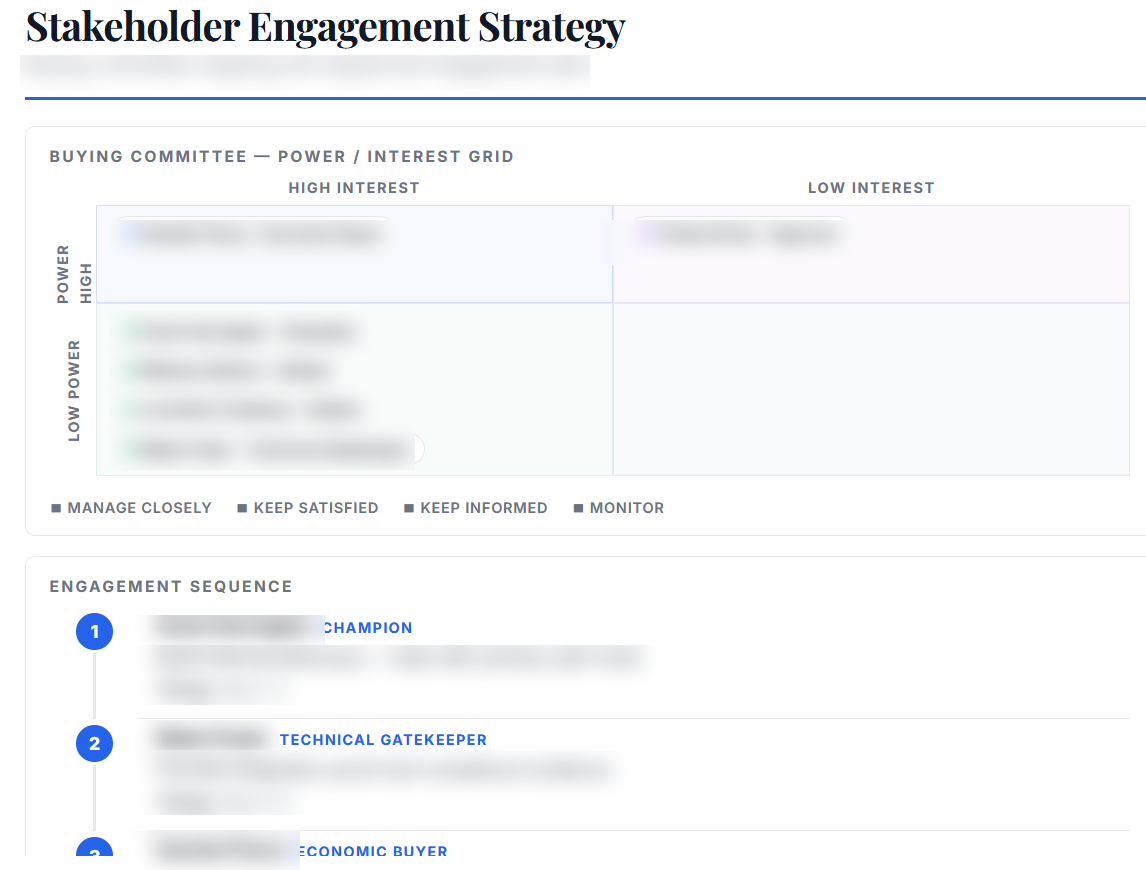
Buying-committee logic No No Sometimes Handled upstream at the ICP/Foundation layer and surfaced into prospect-level qualification
Cost-of-inaction analysis No No If scoped in Root cause → consequence chain, quantified
Cost SDR time only ~$300/mo (tier-dependent) $975–$2,600 per dossier $250 per Dossier (flat)
Scale (dossiers / mo per SDR) ~10–15 (manual cap) ~50–100 (light output) ~5–8 (analyst capacity) 50–100+ (engine-produced, 6-min review)
Meets the standard? No Partial Yes, if scoped Yes, by spec
Why go analyst grade?

Generic outreach gets ignored. Analyst-grade context wins replies.

Buyer Reality

Irrelevance is a deal-breaker

Modern B2B buyers self-serve generic information. They want sellers only when context is real and relevant.

  • 73% of B2B buyers actively avoid suppliers that send irrelevant outreach (Gartner)
  • Buyers prefer self-service for generic information and seller input only for contextual fit decisions
  • Buying groups are larger and harder to map. Individual-only prospect research is no longer enough
  • Stale or generic context erodes trust before the first reply is even considered
Source: Gartner B2B Buying research
Seller Reality

Top performers research first

The sellers who consistently hit quota treat pre-touch research as a non-negotiable.

  • 71% of top performers in APAC always research before outreach, vs 50% of other sellers (LinkedIn State of Sales)
  • 82% of UK top performers always research before outreach (LinkedIn State of Sales)
  • Incomplete or stale data stalls sellers and stalls deals
  • Manual research at this depth is ~6.5 hours per account. Unsustainable at outbound scale.
Source: LinkedIn State of Sales
Projected Outreach Performance by Context Depth
Directional planning ranges from third-party outreach research
Context Level What It Contains Research-Backed Signal Reasonable Lift Best Use
Generic Outreach Light template, broad persona/title targeting, little account context Backlinko: average outreach reply rate is 8.5%, most outreach is ignored Baseline Broad market testing only
Basic Enriched Name, title, company, industry, simple trigger, light personalization Backlinko: personalized subject/body copy improves response by ~+30.5% to +32.7% +30% to +35% Scalable outbound where fit is clear but signal depth is moderate
Analyst-Grade ICP fit, role relevance, trigger timing, company context, pain hypothesis, competitive angle, buying-committee logic Gong: industry, company, individual, and activity-based personalization can create much larger lift +88% conservative · +200% high-context Strategic accounts, intent signals, executive outreach, high-ACV outbound
These are directional planning ranges from third-party outreach research. SDR Flow does not claim guaranteed conversion or closed-won lift.
The ICP operating system. Not another ICP deck.

Two Evidence Layers, One Targeting Framework

Most ICP services turn one methodology into a static document. The Foundation builds one targeting framework from two evidence layers: a Strategic Fit Evidence Layer that measures where the product should win, and a Performance Evidence Layer that measures where it has won, activated when usable CRM history exists. This evidence is composed into a rigorous Targeting Framework: who to pursue, how to pursue, and the competitive landscape — with provenance on every claim.

Why this isn't the ICP work you've bought before

Two Layers, one engine.

01 · Strategic Fit Evidence Layer

Measures where the product should win. Triangulates industry metrics, customer voice, competitor intelligence, USP conjoint analysis, and research-grounded persona role intelligence to identify the markets, company shapes, buyer roles, pain patterns, proof anchors, and competitive openings that make a segment worth pursuing.

02 · Performance Evidence Layer

Measures where the product has won. Activated when usable CRM history clears the coverage and cohort thresholds. Reads closed-won, expansion, renewal, churn, loss, and deal-economics patterns to surface the firmographics, industries, buyer roles, ACV bands, and sales-cycle profiles that historically convert.

03 · ICP Cortex

Conducts a confidence weighted section-by-section analysis of alignment and drift between the two evidence layers, and produces a rigorous Targeting Framework: who to pursue, how to pursue, opportunities, potential challenges, positioning and more.

The ICP Cortex: Our ICP Cortex is a structured analytical engine with deterministic scoring, weighting and evidence evaluation, built on the nexus of industry research and enterprise-strategy level GTM frameworks, all codified into the analysis mechanism. The Foundation is produced by this engine, audited by a specialist, and delivered.
Product-stage, not company-stage

Built for the moment a product needs a pattern.

Whether it's your first product or your fifth, the question is the same: who actually buys this, and how do we know? The Foundation answers it the same way at Series A with no CRM as it does at Series D launching a new SKU.

01 · New product, no data yet
Strategic Fit Evidence Layer runs in full. Performance Evidence Layer returns “unavailable” honestly. Targeting Framework = Strategic Fit Shape. A clear shape and a path to validate it.
02 · Existing product, building CRM history
CRM evidence is partial. Composer down-weights the Performance Evidence Layer where confidence is thin and shows you exactly where Strategic Fit and Performance agree, diverge, or lack evidence.
03 · New product / new motion at an established company
The blind spot of every history-trained methodology: a CRM full of the wrong product's history. Strategic Fit runs against the new SKU; Performance runs only on the cohort that touched it. Same engine, scoped correctly.
What you get

Four interlocking assets. One closed loop.

CORE The ICP Definition two evidence layers · one targeting framework
defines
01
ICP Report
40+ pages, board-grade
02
Sales Deck
Executive PPTX
03
3-Level Scorer
Account-level grading
04
Analytics
Wired to the scorer
Operating signal loops back to the definition. Tier-weighted performance, persona × tier wins, and signal-tag distribution feed the refresh. The thesis sharpens every cycle.
01 · The ICP Report

40+ pages, board-grade

The strategic source of truth. Answers who, why, and how, backed by evidence rather than assertion. Every section traces to source.

  • Market viability modeled against NAICS, U.S. Census CBP, and BEA GDP data
  • Industry intelligence sized against client company-size bands
  • Competitive landscape with battle cards from G2 review evidence (up to 10 competitors)
  • Customer intelligence and lookalikes, real sentiment, real comparable accounts
  • Need–solution mapping scored against persona affinity
  • Buyer-decision profiles drawn from a library of 292 pre-modeled buying behaviors
  • Persona intelligence drawn from a 91-role behavioral library
  • Six-dimension fit scorecard: Market Size, Growth, PMF, Competitive Position, Buyer Accessibility, Proven Success
  • 90-day roadmap, qualification gate, and messaging preview
Landscape PDF / HTML · ~32 pages typical · narrative per section
02 · The Sales Deck

Executive PPTX, 19+ pages

The boardroom version of the strategy. Built to defend the ICP in front of a CRO, a CFO, or a buying committee. Not a glossy pitch.

  • Cover · Executive Summary · ICP Snapshot · Outreach Strategy
  • Personas · Persona Comparison · Battle Cards (up to 10 competitors)
  • Market Leaders & TAM Distribution · Sentiment Analysis
  • Value Propositions by Persona · Discovery Questions · Objection Handling
  • 12-Week Outreach Cadence · Sample Outbound Emails
  • Framework Rankings · KPI Targets · Lookalike Targets
  • Risk Assessment · Data Provenance · Sources & Methodology
PPTX · 19 + N personas + B battle cards · boardroom-grade
03 · The 3-Level ICP Scorer

Strategy converted into account-level decisions

Every account is graded on three layers, with a transparent score and an evidence trail.

  • L1, Company. Firmographic fit: industry, company size, geography, revenue, tech stack.
  • L2, Account Signals. Hiring velocity, social activity, product signals, price-point alignment, org structure, financial health, competitive displacement, optional Bombora intent overlay.
  • L3, Prospect. Role match, buying archetype, champion potential, composited with L2.
  • Tier A (80–100) work now · B (65–79) work next · C (50–64) qualify before investing · D / F sub-threshold or disqualified.
  • Disqualification is codified — blacklist domains, excluded verticals, minimum headcount and revenue, named triggers. Every “no” has a reason.
  • Shape lens. Scorer reads the Targeting Framework by default; the Performance Shape is available as a parallel scoring lens for sales-leadership review.
L1 + L2 + L3 · tiered A–F · codified disqualification gates
04 · Analytics, Wired to the Scorer

Closed-loop measurement

Bound to the same ICP definition and tier the scorer assigns. Performance is always measured against the strategy that produced it.

  • Account audit — score, tier, layer depth, enrichment status, dimension breakdown, disqualification reason
  • Tier-weighted performance — engagement, response, and conversion by Tier A / B / C
  • Persona × tier — which personas respond inside which tiers
  • Framework × tier — which messaging frameworks win where
  • Signal-tag distribution — which buying signals concentrate in best-fit accounts
  • Time-to-response and time-to-conversion by tier — proof that A-tier really is faster
A measured thesis, revised every cycle, not a one-time opinion
How the work is built

Built on evidence, not opinion

Each asset is triangulated from product truth, buyer-role intelligence, market structure, customer voice, competitive pressure, and GTM research. The rigor is structural, not stylistic.

Customer voice
Real sentiment from actual buyers

What buyers praise, what they complain about, which company sizes are satisfied, where competitor products create frustration. So sellers know what to say, and to whom.

Industry grounding
Market, TAM, and methodology checks

Firmographic qualification, TAM viability, buyer-committee logic, need–solution mapping, competitive positioning. Benchmarked against Gartner, McKinsey, Forrester, GTMnow, Census, BEA, and NAICS. So the thesis defends itself in front of a CFO.

USP validation
Claims tested before they become messaging

Each claim is tested against buyer pain, role relevance, proof strength, customer sentiment, competitor capability, and market validation. So sellers carry claims that hold up under pressure.

Conjoint-style analysis
Buyer trade-offs across a broad review surface reveal which capability combinations actually drove the win.
Data provenance
A traceable evidence trail

Every output traces to a source family: company context, capabilities, pains, value props, USPs, proof anchors, persona intelligence, buyer-decision patterns, customer evidence, competitor intelligence, benchmarks, TAM data, enrichment, and outcomes. So nothing is asserted without provenance.

Pre-Dossier Value

Before a single dossier is delivered

Foundation tightens who teams pursue, who they ignore, and how they open the conversation.

  • Firm ICP definition. Quantified, scored, and operationally enforceable.
  • Exclusion criteria for bad-fit accounts. Stop spending SDR time on prospects that should never have entered outbound.
  • Account & persona prioritization logic. Clear rules for who gets touched first, second, never.
  • Outreach angle guidance & qualification thresholds. SDRs start better-armed before dossier scale begins.
SDRs reclaim significant focus before dossier #1 ships
Not a deliverable. A foundation.
Strategic build

The ICP your team can actually operate on.

We turn your customer evidence, role data, and competitive landscape into a quantified, confidence-scored ICP. Every dossier we produce is calibrated to it.

Diagnostic
For teams who want to prove the method on their data before the full build.
Book a Strategy Session
Foundation +
For revenue orgs running distinct motions or segments under one workspace.
Book a Strategy Session
Foundation Enterprise
For multi-region, multi-brand, or multi-SKU programs with governance needs.
Book a Strategy Session
Build scope
Deliverable type
ICP audit + 5 seeded dossiers
Full ICP build
Multi-ICP build
Multi-program build
ICPs produced
1 (audit)
1 complete
Multiple
Multi-region / multi-SKU
Seeded dossiers included
5
25
75
Per program
Workspaces included
1
1
1
Multi
What the ICP Cortex delivers
Strategic Fit Evidence Layer
End-to-end on your data
Performance Evidence Layer
On a CRM slice
ICP Report (board-grade)
Per ICP
Per ICP
Sales Deck (executive PPTX)
Per ICP
Per ICP
Cross-ICP prioritization
Specialist audit and walk-through
Engagement & governance
Recalibration cadence
N/A
Semi-annual
Quarterly
Quarterly
Multi-region / multi-brand / multi-SKU
Governance, SSO, advanced RBAC
Diagnostic credit toward upgrade
100%
Plans and pricing

Built for the volume your motion actually does.

Every plan runs the same Foundation, the same NIEOS GTM Orchestrator, and the same dossier production system. What changes is monthly volume and included users.

Operator
A focused operating plan for teams running a single ICP with steady weekly volume.
Book a Strategy Session
Growth
For revenue orgs running outbound across multiple segments or driving heavier monthly volume on one ICP.
Explore with a quick call
Custom
Multi-ICP, multi-region, or enterprise governance. Banded to scope, finalized in a written SOW.
Explore with a quick call
Volume
Monthly dossier production
25 / mo
50 / mo
100 / mo
250+ / mo
NIEOS GTM Orchestrator
Find Companies
Firmographic discovery and filtering
Find Lookalikes
Account-similar search seeded from your ICP and wins
Find People
Contact discovery with verified phones and emails
Detailed People + Company enrichment
Custom data tables
Clay- and Airtable-style GTM sandbox, the core workspace UI
AI actions on rows
Row-level AI enrichment, drafting, classification
Webhooks
Inbound and outbound
2-way Salesforce + HubSpot integration
Bidirectional sync, both CRMs
3-Level ICP Scorer (Company × Account × Prospect)
ICP Dashboard Analytics
Monthly enrichment credit
$500 / mo included
$1,500 / mo included
$3,000 / mo included
Scoped
Intent Module (Bombora layer in scorer)
Coming soon · add-on
Coming soon · included
Access
Active users included
5
10
20
Scoped
Workspaces included
1
1
1
Multi
SSO and advanced RBAC
Foundation
Starts from $9,400 (Diagnostic, 3 weeks, 100% credited toward Foundation upgrade). Full Foundation is scoped to ICP complexity.
Operating Plans
Starts from $6,250 / month at Operator.
Custom & Enterprise
Banded to workspace count, ICP count, governance scope, and recalibration cadence. Finalized in a written SOW with phased milestones, security review, and acceptance criteria.
Integrated ROI

See the engagement against your numbers across four pillars.

Edit the inputs to your own ACV, win rate, SDR loaded cost, and current preparation depth. Productivity, conversion quality, speed, and pipeline value update together.

Inputs
Productivity
SDR Time Reclaimed
Analyst-Equivalent Capacity
Prep Hours Removed / Account
Conversion Quality
Opportunities
Reclaimed-Time Opportunities
Total Uplift
Cost Per Opportunity
Current Prep Depth
Analyst Dossier
Daily SDR loaded cost divided by opportunities produced per day at each prep depth.
Expected Revenue Impact
Annual expected closed-won value
ROI Scenario
Foundation
ICP Mode
Methodology
CFO Summary Industry-standard metrics for procurement review
Payback Period
Modeled cost / projected monthly net benefit
3-Year Benefit/Cost
Cumulative benefit vs cost over 36 months
Net 3-Year Value
Projected benefit minus modeled cost over 36 months
Based on selected plan cost and included setup assumptions. Benefits are scenario projections, not guarantees.
Numbers are scenario assumptions, not benchmark guarantees. ACV, win rate, and prep-depth funnel rates are editable. Industry funnel benchmarks for prep tiers are drawn from Apollo, Outreach, Smartlead, Lavender, and Belkins state-of-outbound reports. The standalone calculator supports Replace Mode (vs assembled stack) and per-tier break-even.
Frequently asked

Common questions, answered.

01 · GETTING STARTED
Is this the right fit for us?
For founders, RevOps leads, and anyone evaluating a pilot.
What does a finished ICP and dossier look like? Can I see one? +

We will provide a redacted sample during your strategy session along with an ICP example. The Anatomy of a Dossier page describes the structure of a Dossier, while the Foundation page describes the structure of the ICP.

Who is SDR Flow for, and who isn’t it for? +

Strong fit: $45,000 ACV+ B2B teams running ABM motions who would prefer their SDRs and sales teams spend more time selling than prepping and researching; teams who need or have a defined ICP but have no concept of how to operationalize it in real time; teams with multiple product lines who need to define targeting; teams that understand the positive relationship between relevance, context depth, and a higher win percentage.

Weak fit: B2C and pure inbound-only motions; B2B teams with no ICP and no intention to start with the Foundation.

How fast can we be live? +

Diagnostic Foundation: ~3 weeks. First dossiers ship within ~1–2 weeks of Foundation completion. Pilot teams are typically delivering on real accounts inside the first month.

My ICP isn’t fully defined yet. Will the Foundation work for me? +

That’s exactly what the Foundation is for. The methodology is built to handle pre-PMF and re-pivot situations, teams who have a working hypothesis but haven’t formalized scoring criteria, persona models, or signal definitions. If you already had all of that, you’d need a platform, not a Foundation.

The Diagnostic is designed for exactly this case: prove the methodology on your data, get 5 seeded dossiers, decide if the full Foundation is worth it. 100% of the Diagnostic credits toward the Foundation upgrade. See the Pricing tab for details.

Are you a software product or an agency? +

We are a full-funnel revenue agency, unique in that we provide the strategy layer, operational layer and the platform in a single integrated engagement. The end result is a comprehensive GTM methodology on semi-autopilot, from strategy to prospect outreach. The NIEOS is the GTM orchestration layer your team uses to operate it.

What is the engagement model? +
  • Stage 01 · Analysis. You define your objectives which guides the scope of the engagement over a strategy session.
  • Stage 02 · Intake. We provide you with intake forms to collect pertinent data and CRM sample if applicable, and provision your operational workspace.
  • Stage 03 · Delivery. We provide access to the orchestration system if applicable and deliver the board-grade Foundation and Sales Deck.
  • Stage 04 · Operation. You operate the orchestration layer with access to the ICP scorer and analytic feedback, to produce dossiers at your discretion up to the applicable limits.
02 · PRICING & COMMERCIALS
How do the dollars work?
For procurement, finance, and the budget owner.
What drives the pricing of your Operation Plans? +

Most ICP agencies provide a sales deck and then a retainer for advice. We provide the ICP playbook and deck, along with the means for you to operate that ICP via company/prospect level ICP alignment scoring, analytic feedback, and analyst-grade prospect dossiers. Our Operation Plans are priced on the Dossier asset itself, scaled with the needed volume. The orchestration layer is afforded at no additional cost.

What’s the minimum commitment? Can I cancel after a few months? +

Monthly plans run month-to-month after the Foundation is delivered, cancel any time with 30 days’ notice. Annual plans get the discounted rate in exchange for a 12-month term. For operation plans purchased without the Foundation, the minimum commitment is 3 months.

Can I bring my own ICP? +

Yes. SDR Flow ingests your existing ICP definition (document, spreadsheet, HubSpot/Salesforce scoring config, or written brief) and calibrates the scorer’s weights to match your fit criteria.

What if my SDRs don’t use all the dossiers I paid for? +

Unused dossiers roll forward for 30 days, up to one month’s plan volume, oldest consumed first. Annual contracts may pool quarterly.

What happens if we go over plan, and how will I be warned? +

There is a credit tracker and a dashboard that clearly displays how many dossiers have been exhausted and how many remain. Overage or tier upgrades are available when dossiers are exhausted.

Do you replace dossiers that come back off-target? +

If a dossier has missing content in the analysis areas due to error, we will replace it immediately.

03 · TRUST, DATA & SECURITY
What does your security team need to know?
For infosec, legal, and procurement reviews.
Where does your data come from, and how good is it? +

Quality is at parity with the leading providers in this category. We multi-source from a curated stack of best-in-class data partners, firmographic, workforce, intent, and contact, and reconcile across them, so coverage and accuracy are stronger than any single-source vendor.

Can I bring my own data and my own API keys? +

Bring your own data: connect HubSpot or Salesforce, import a CSV, or upload account and contact datasets. Export any of it back out to CSV at any time, with enrichments and ICP scores attached at the row level.

Bring your own keys: AI operations, formulas, and workflows can run on your LLM keys.

Who owns the dossiers, and what happens if we cancel? +

Nothing dramatic. Most of it was already yours.

Imported data — yours from the moment you upload it. Exportable any time. No termination needed.

Generated dossiers — saveable as PDF or printable the moment they’re produced. Yours to keep, contract or no contract.

Foundation deliverables — delivered the moment the Foundation is built. The written ICP definition, persona profiles, qualification playbook, and enablement deck are documents you receive, own, and can use anywhere from day one. Unlike platforms that bury your strategic config inside their UI, our deliverables exist as standalone artifacts.

How does this fit our CRM and BI stack? +

HubSpot & Salesforce: native OAuth connection. Once connected, workflow automations can push contacts, deals, and custom objects from SDR Flow into your CRM and read records back, including SOQL queries against Salesforce. Useful for syncing ICP scores and dossier links onto records, or pulling existing accounts in for scoring.

Webhooks available inside workflow automations for custom downstream integrations.

Where is data stored, and what’s your security posture? +

Hosting: DigitalOcean App Platform (US region) with managed PostgreSQL and managed Valkey/Redis. Encryption at rest and TLS in transit are provided by the managed services. Other regions available on Enterprise scoping.

Compliance posture: the platform is architected for SOC 2 / GDPR-style controls, tenant isolation, audit trails on data access, least-privilege roles, change management on production. We are not currently SOC 2 or ISO 27001 attested. Customers who require a current attestation today should plan for that gap; customers who need it on a roadmap can scope it as part of an Enterprise engagement.

Sub-processors: hosting (DigitalOcean), data and intelligence partners, and AI providers. The current sub-processor list is provided under NDA during procurement review.

The next step

Operational ICP.
From Playbook to Prospect.

Talk to us about your ICP, your motion, and your dossier volume. We'll scope a Foundation, anchor a plan, and show you exactly what the first 50 dossiers will look like.